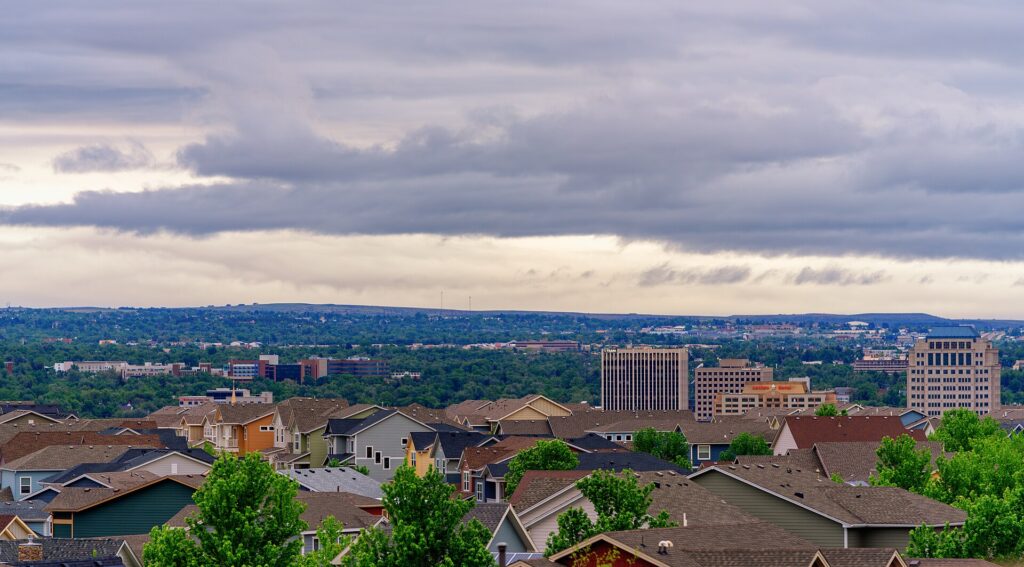
I’ve lived on the west side of Colorado Springs for twenty years, and the question I get most from people thinking about moving here is simple: is it still cheap? The honest answer, as of today, August 31, 2026, is that it depends what you’re comparing it to. It’s not the deal it was ten years ago. It’s also still noticeably cheaper than Denver, Boulder, or either coast. Here’s what the actual numbers say right now, not a guess pulled from a couple years back.
What a house actually costs right now
Redfin’s Colorado Springs housing market report, pulled today, puts the median sale price at $459,650, down 3.1% from a year ago, for the three months ending in June 2026. That’s for the whole metro. Price per square foot is $211, also down slightly year over year, and homes are sitting on the market about 41 days before they sell. That’s a real shift from a few years back when everything moved in under two weeks.
A second source, Resideline, tracked the last six months of closings and landed on a median sold price of $450,000 across nearly 4,000 sales, with the middle half of homes selling between $370,000 and roughly $592,000. Both numbers point to the same place: call it $450,000 to $460,000 for a typical home right now, not the $475,000 figure you’ll still see floating around on older pages.
What rent actually costs right now
For rent, I lean on Apartment List’s September 2026 report, which tracks actual asking rents. As of that pull, the overall median in Colorado Springs is $1,359 a month. A one-bedroom runs $1,123, a two-bedroom $1,315. Rents here are down 1.5% from a year ago, and they’re running about 2.2% below the national median. That’s the number that matters if you’re apartment hunting today.
There’s a separate government number worth knowing if you’re dealing with a housing voucher or comparing across cities: HUD’s FY2026 Fair Market Rent schedule for the Colorado Springs area sets a studio at $1,196, a one-bedroom at $1,464, a two-bedroom at $1,735, a three-bedroom at $2,413, and a four-bedroom at $2,744. That’s not what you’ll pay on a random listing. It’s a 40th-percentile gross rent figure, meaning it includes basic utilities, and HUD uses it for its own programs, so don’t read it as “average rent.” If you see a listing site quoting something closer to $1,850, that’s usually pulled from active listings only, which run higher than what people across the whole market are actually paying.
How rent here stacks up against Denver
Using that same HUD FY2026 schedule, a two-bedroom in Colorado Springs runs $1,735. In Denver-Aurora-Centennial it’s $2,089. Boulder is $2,124. Fort Collins-Loveland is close to us at $1,732. Pueblo is the cheapest of the group at $1,269. This is a rent-schedule comparison, not a full cost of living index, but it answers the question I get asked constantly: yes, we’re still meaningfully cheaper than Denver and Boulder on housing.
| Metro area | 2-bedroom Fair Market Rent (HUD FY2026) |
|---|---|
| Colorado Springs | $1,735 |
| Denver-Aurora-Centennial | $2,089 |
| Boulder | $2,124 |
| Fort Collins-Loveland | $1,732 |
| Pueblo | $1,269 |
Gas and state taxes, the numbers people forget
AAA had Colorado Springs metro regular gas at $4.10 a gallon as of today. The statewide Colorado average is a little higher at $4.26, and the national average is $4.08, so we’re sitting almost exactly on the national number and below the rest of the state.
On income tax, Colorado runs a flat 4.40% state income tax rate, which has been the rate since the 2022 tax year and is still what’s on the books according to the state’s own Department of Revenue. No brackets to climb, no surprises.
Where you live changes the math
I get asked which part of town to look at, and honestly, I wouldn’t call any part of Colorado Springs a bad area. But the character is different depending on where you land. I’m on the west side, up against the mountains, and it’s more established, more trees, quieter than a lot of the rest of the city. The east side is where the stores and restaurants are, if you want to be near shopping and a more active evening scene, especially further north around Briargate and Northgate. The south side, near Cheyenne Mountain and the Broadmoor, is well established too, older neighborhoods, more trees, a little slower pace than the east side. Southeast, near the airport, you’ll find more people connected to Fort Carson and Peterson. Downtown doesn’t have a lot of housing stock, mostly older homes, though the North End has some genuinely nice ones.
None of that changes the citywide numbers above, but it’s worth knowing before you start narrowing a neighborhood down.
So, still affordable?
Compared to Denver, Boulder, or either coast, yes. Compared to five years ago, no, it’s not the deal it used to be. Home prices are actually down slightly from last year and rents are down too, so the trend right now is easing, not tightening. If you’re weighing a move, I’d watch the same three numbers I watch: the median sale price, what a two-bedroom actually rents for, and gas, because that’s the cost that moves the most month to month. Those numbers are all above, dated today, with the source linked so you can check them yourself before you decide.
Related guides
- Best Neighborhoods in Colorado Springs
- The West Side vs. the East Side: A Local’s Honest Take
- Moving to Colorado Springs
- Old Colorado City Stores

Leave a Reply